
There is a man who comes into a coffee shop in Jhamsikhel every morning at ten past eight. Black coffee, no sugar, drunk standing at the counter while he reads something on his phone. He has done this for two years. The girl who makes it knows his order before he opens his mouth. Neither of them knows the other's name.
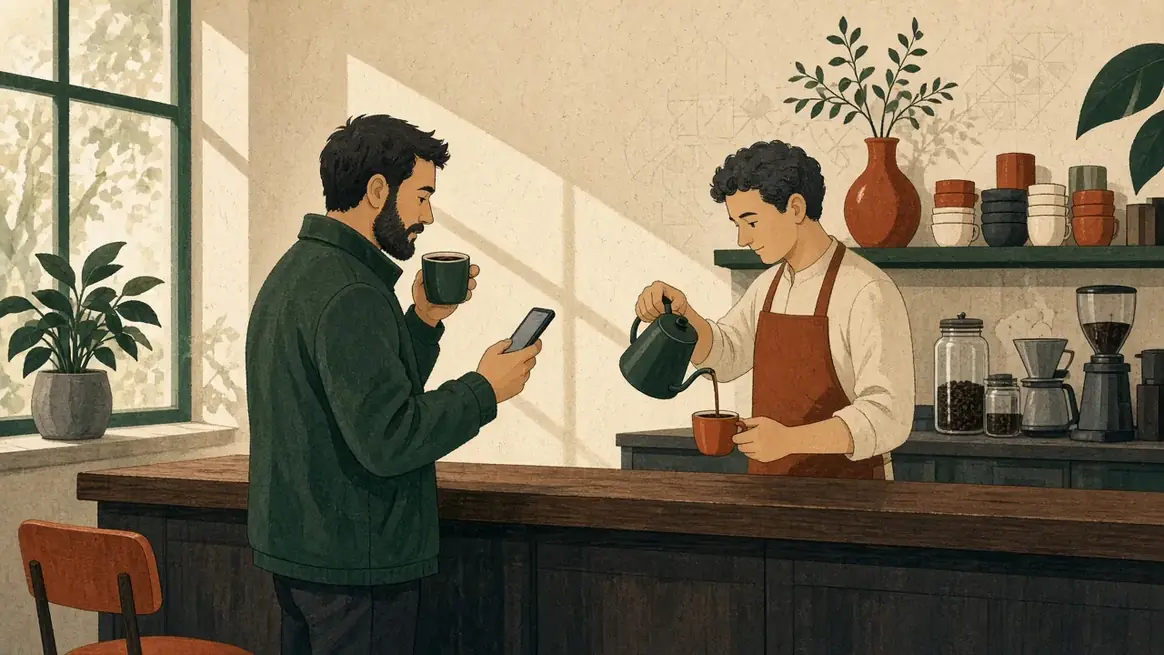
That man is the most valuable thing in the shop, and the shop cannot prove he exists. He is not in a spreadsheet. He is not on a list. If he moved to Pokhara tomorrow the takings would drop and nobody would be able to say why for a month.
Most small shops in Nepal have a dozen of him. And most of them, when they want more business, do the one thing that pushes him further away: they cut the price.
A discount is a sale, and a card is a habit
Think about what a discount actually buys. You put twenty per cent off in a Facebook post. People come. Some of them are new. They buy the thing at the lower price, and then they go home.
What have you taught them? You have taught them that your price is negotiable, and that the smart move is to wait. The next time they see your shop they will look for the offer, and if there is no offer they will feel slightly cheated by the normal price. You have not built a habit. You have trained a reflex, and the reflex is to wait for the next discount.
A card does the opposite. A card says: keep coming, and the tenth one is on us. The customer who is four stamps in has a reason to walk past the other cafe on the corner. Not a strong reason. A small one. But small reasons repeated twenty times a month are what a business is made of.
You are already paying to be forgotten
Getting a new customer costs real money. A boosted post, a banner, a discount that eats your margin, an hour of your own time spent on Instagram instead of behind the counter. Every shop knows roughly what that feels like even if nobody writes it down.
Getting an old customer back costs a smile and a card that remembers. The person has already found you, already decided you are acceptable, already knows where the door is. The hard part is done. And yet almost all the effort in a small shop goes into the first group and almost none into the second.
This is not a Nepali problem, it is a small business problem everywhere. But it bites harder here, because in a Kathmandu neighbourhood there are four shops selling the same thing within two hundred metres, and the only real difference between them is whether anybody feels known.
The arithmetic, honestly
Pasal counts a point for every Rs 100 a customer spends on an order you have marked paid. That is the whole rate. No tiers, no multipliers, no clever maths.
So a hundred points means the customer has spent Rs 10,000 with you. If your reward at a hundred points is a free chiya, you have given away Rs 30 of tea against Rs 10,000 of sales. If it is a free cake, call it Rs 250 against Rs 10,000. Two and a half per cent, and only paid out to somebody who has already proved they come back.
| Reward | Given away | Against sales |
|---|---|---|
| Free chiya | NPR 30 | NPR 10,000 |
| Free cake | NPR 250 | NPR 10,000 |
Now put that next to the twenty per cent you knocked off for a stranger who never returned.
The point of writing it out is that the numbers are not scary once you see them. The mistake shops make is not being too generous. It is being vague, and then quietly not honouring anything, which is worse than having no card at all.
The card lives where their bus pass lives
The old version of this was a paper card with ten little squares and a rubber stamp. It worked. It also lived in a wallet, went soft, went missing, and got left in a jacket at home on exactly the day the customer earned the free one.
A card in Apple Wallet or Google Wallet does not get left at home, because the phone does not get left at home. Your customer signs in on your shop page once, adds the card, and it sits with their boarding passes and their event tickets. You choose what it looks like: a stamp grid or a points bar, your own word for a point, your colour, your logo. It is your shop's card, in a place they open twenty times a day.
There is a pin on it too, so an installed card can surface when they are near the shop. That is a small thing that does something no paper card ever did.
Honour it at the counter, because that is where being known happens
Here is the part of Pasal's loyalty that people find surprising, and it is deliberate. Pasal does not email a discount code. It does not take money off at the checkout. It counts, and you honour it at the counter.
That sounds like a missing feature until you think about what a loyalty card is actually for. It is not a payment mechanism. It is a way of being recognised. The moment worth having is the one where the customer shows you the card, and you say "that is your tenth, this one is on me", and hand it over. An automatic discount applied silently by a website is a rebate. A person at a counter saying you are a regular is loyalty.
So the flow is simple. They show the card. You give them the thing. Then you open their row in Customers, press Adjust, redeem the points, and write what it was for. It stays on their record with your note, permanently, so when somebody asks in three weeks why their balance moved you can tell them.
Start with one sentence you can say out loud
The best loyalty rule is one a busy staff member can repeat correctly at six in the evening with a queue forming. "A hundred points is a free coffee." That is it. If your rule needs a second sentence to explain it, simplify it.
Then leave it alone for a few months. A card people trust is worth more than a card that is cleverly optimised, and nothing destroys trust faster than a reward that changed while somebody was saving for it.
The man in Jhamsikhel does not need a discount. He is already coming. What he needs is for somebody to notice that he has been coming for two years. That is cheaper than an advertisement, and it works on the customers you already have.
Loyalty is a Pro tool in Pasal. On the free plan no new points are earned, but points a customer already holds can still be spent, so nobody loses what they saved with you.
When you are ready to set one up: design the card your regulars carry and setting a reward people will actually chase.