
Setting a reward people will actually chase
What a hundred points really costs you, why an unreachable reward is worse than none, and how to change your mind later.
The board will let you set any threshold and any prize. Neither is a small decision, and both are easier once you have done the arithmetic once, so here it is.
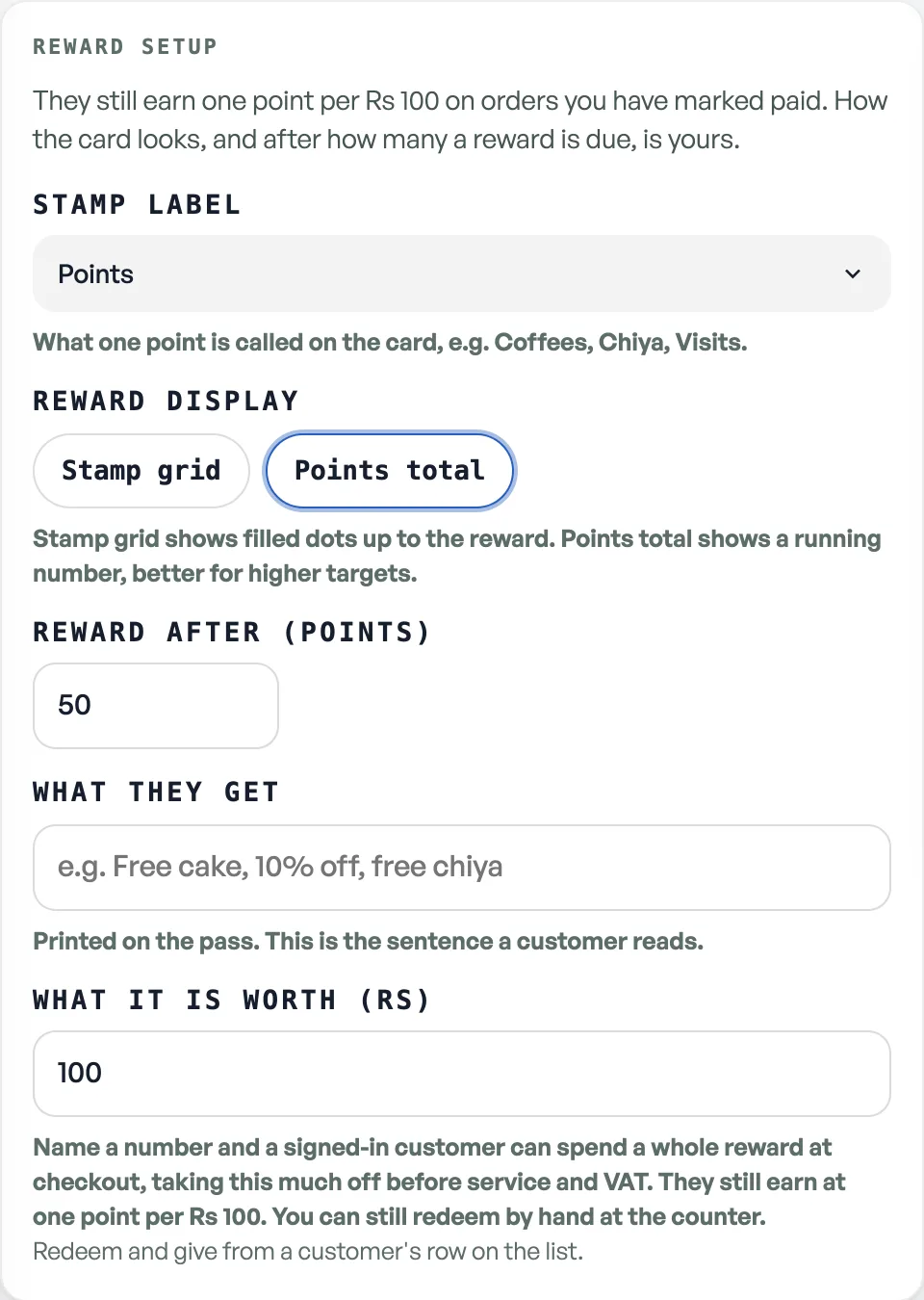
What a hundred points costs you
A point is Rs 100 spent on a paid order. So a hundred points means a customer has spent Rs 10,000 with you. That is the only sum you need.
A free chiya against Rs 10,000 of sales is well under one per cent. A free cake is around two and a half. Ten per cent off a next order is a real cost and is worth thinking about twice, because it scales with whatever they buy next rather than being a fixed thing you control.
Set that next to what a discount aimed at strangers costs you, and most shops find they have been far more generous to people who never came back.
Reachable beats generous
The commonest mistake is not being too generous. It is setting a number nobody reaches.
Work out what a normal customer spends in a month, and choose a threshold they could hit in two or three. A reward that takes a year arrives after the customer has stopped believing in it, and a card that never pays out is worse than no card, because it is a promise the shop visibly failed to keep.
If your average sale is Rs 300, a customer earns three points a visit. Twenty visits is sixty points. Fifty is a threshold somebody could reach; five hundred is a threshold nobody will.
One sentence, said out loud, at six in the evening
The test of a loyalty rule is whether a busy staff member can repeat it correctly to a customer with a queue forming behind them. "A hundred points is a free coffee." If your rule needs a second sentence, simplify it until it does not.
Tiers, multipliers and double points on Tuesdays all sound like more marketing and are in practice less, because nobody at the counter can explain them and so nobody mentions them at all.
Changing your mind without cheating anybody
You will want to adjust this, and you can. The care is owed to people who were already saving.
If you are making the reward easier, just change it. Nobody is harmed by arriving somewhere sooner. If you are making it harder, or swapping the prize for something cheaper, honour the old rule for anybody already close to it. Use Give on their row to top somebody up to the old threshold, write the reason in the note, and let them have it.
That costs a few hundred rupees across a handful of customers, and it buys the thing the whole card exists for, which is a regular who believes the shop keeps its word.
Leave it alone for a while
A card people trust is worth more than a card that is cleverly tuned. Once the rule is simple and reachable, give it a few months before you touch it. Loyalty is measured in return visits, and a scheme rewritten every fortnight never lasts long enough to produce one.
Loyalty is a Pro tool. When Pro ends the dashboard locks until you subscribe. Points already earned stay on the customer.
- Reward regulars with loyalty pointsRegulars earn a point per Rs 100 they spend. Redeem them, give them, and see what you gave.
- Design the card your regulars carryStamps or points, your own word for one, the reward, the colour and a logo. What each choice does.
- Run a promo codeCreate a discount code customers type at checkout.