
Design the card your regulars carry
Stamps or points, your own word for one, the reward, the colour and a logo. What each choice does.
Points are counted whether or not you have designed anything. The card is what the customer actually sees, and it lives behind the Design loyalty card pill on the Customers tab. Everything on that board is paint and words. None of it changes how points are earned, which is always one point per Rs 100 on orders you have marked paid.
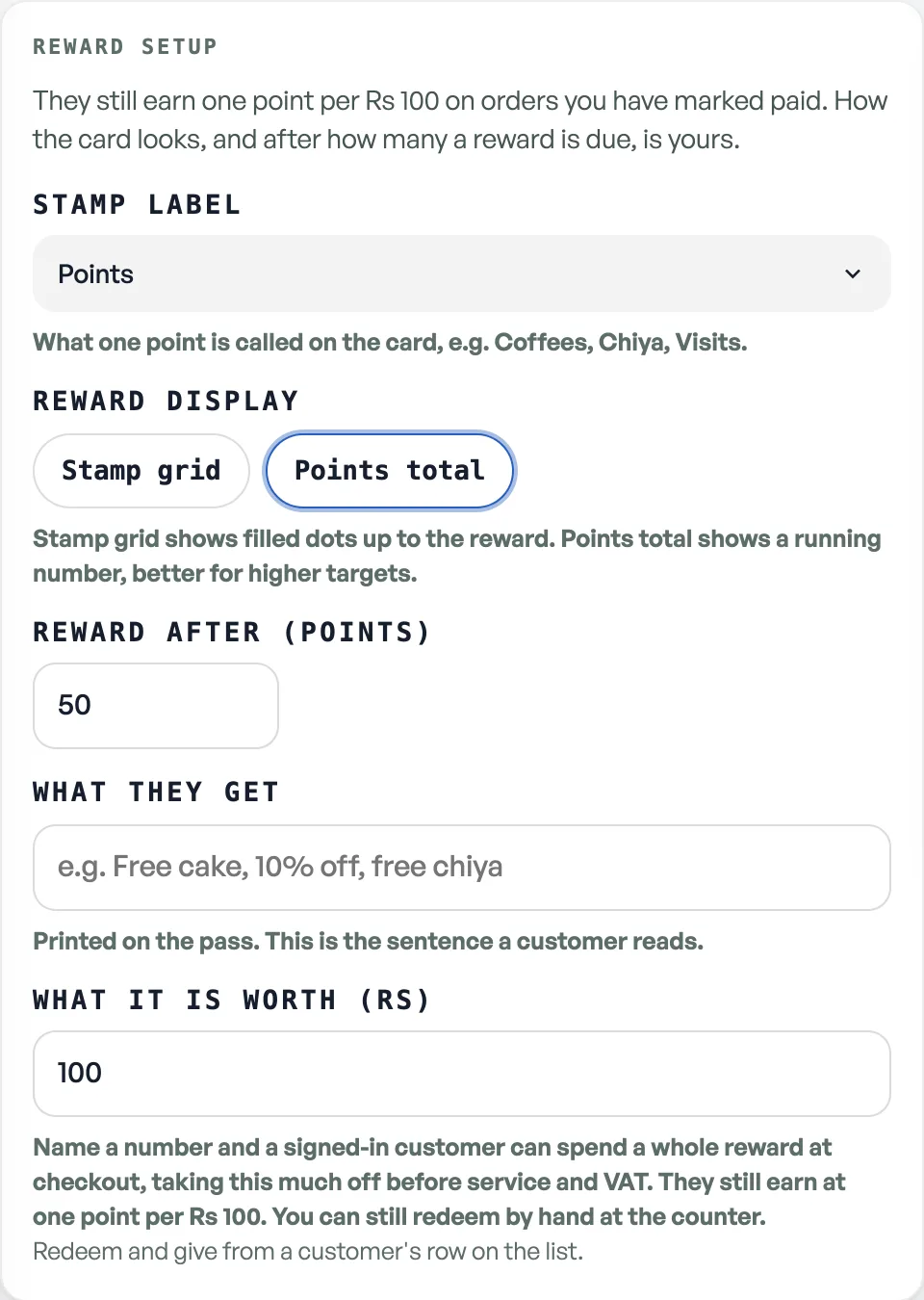
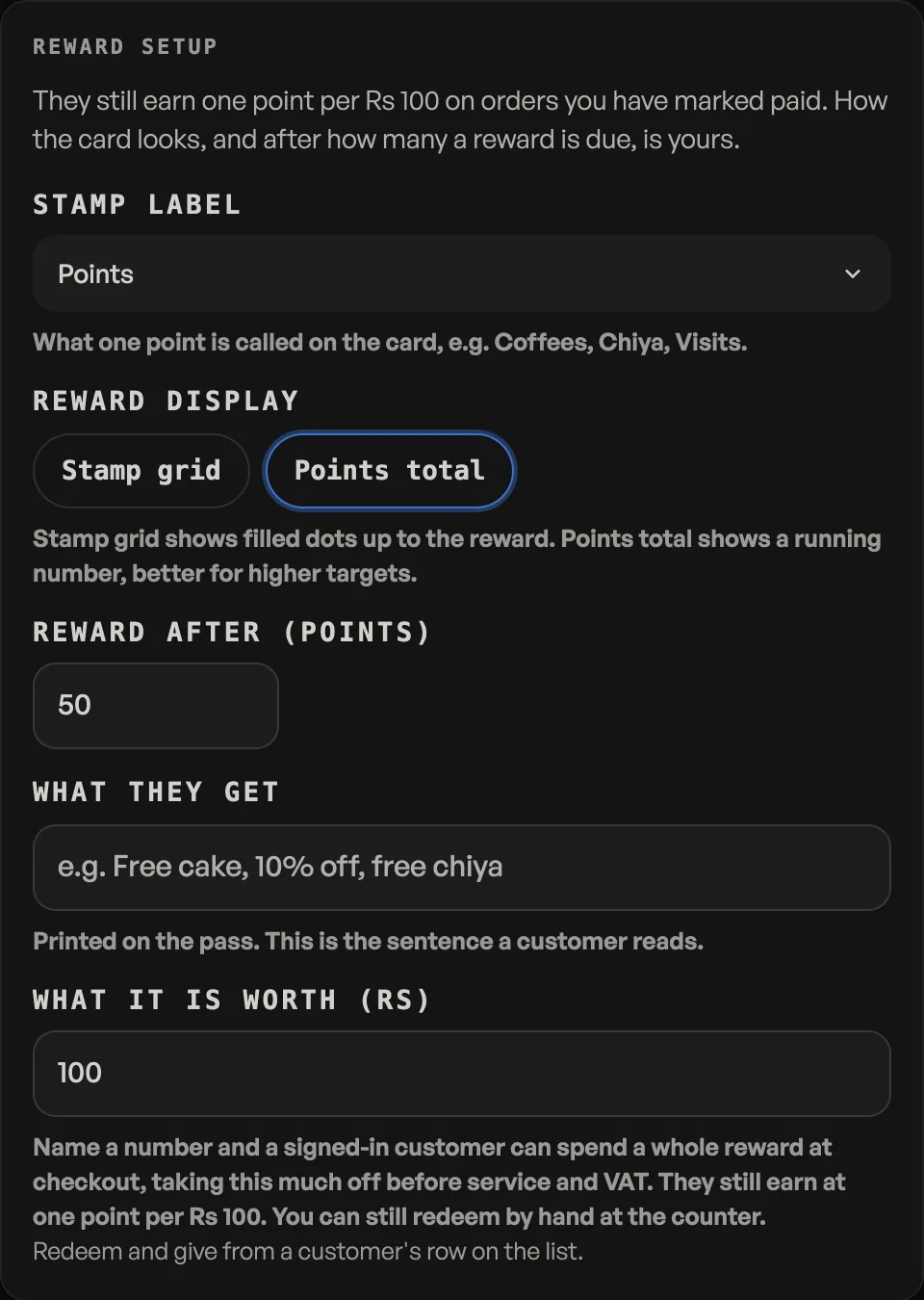
Stamps or a points bar
A stamp grid draws one box per point and fills them in. It suits a shop where a customer buys roughly the same thing at roughly the same price: a cafe, a momo place, a barber. Ten squares and a free one at the end is a rule anybody understands without being told.
A points bar shows a total creeping towards a number. It suits a shop where a visit might be Rs 200 or Rs 20,000, because a stamp would mean two completely different things on two different days. A jeweller, a fabric shop, an electronics counter.
If you are unsure, pick stamps. It is the easier one to explain across a counter.
Your own word for one point
Change Stamp label to whatever your shop already says out loud. Cups, plates, cuts, visits, stars. The word prints on the card, so a card that says nine cups reads better in a coffee shop than one that says nine points. Use the singular; the card handles the rest.
The reward, and the sentence that explains it
Three fields do this work. The threshold is how many it takes. What they get is the sentence printed on the card: "Free cake", "10% off", "Free chiya".
Write it as the thing, not as the mechanism. "Free chiya" is a promise. "Redeem 100 points for a beverage of equivalent value" is a terms and conditions page, and nobody reads one of those on a loyalty card.
What it is worth (Rs) is the third, and it is the one that decides how the reward is honoured. Leave it at 0 and the card only counts: you hand the reward over at the counter and redeem the points from the customer's row. Put a figure in it and a signed-in customer can take that much off at checkout, and the counter can take it off a bill for you. The line under the box says which of the two you are in.
Colour, logo and the pin
The card takes one colour and Pasal picks readable text for it, so a dark teal and a pale yellow both work without you thinking about contrast. The logo is a small mark rather than a full signboard: it is drawn at about the size of a thumbnail, so a simple shape survives and a detailed photograph does not.
The pin is a location. An installed card can surface on the customer's phone when they are near it, so it is worth setting to the shop door rather than the neighbourhood.
Check it in both previews before you save
The board previews the Apple Wallet and Google Wallet shapes live as you type, and they are not identical: one gives a long word more room than the other. If your shop name or your reward sentence is long, look at both tabs before you save, because a card that reads well in one and truncates in the other is a card half your customers see broken.
- Setting a reward people will actually chaseWhat a hundred points really costs you, why an unreachable reward is worse than none, and how to change your mind later.
- Run a promo codeCreate a discount code customers type at checkout.
- Point a promo code at one event or a few productsNarrow a code to your tickets, your goods, or a named handful of either.