
Somebody asks us this most weeks. I want a website for my shop. What does it cost?
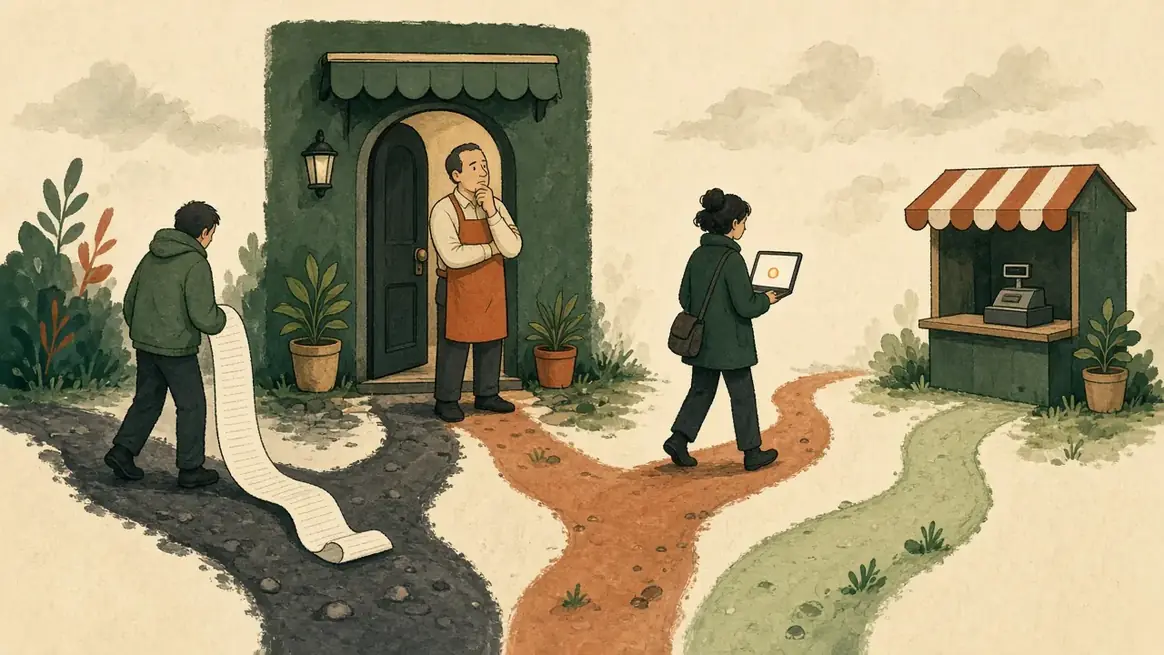
The honest answer is that the price you are quoted is rarely the price you pay, because a shop website is not a thing you buy once. It is a thing you keep. So here are the three routes people actually take, with the first bill and the running one, and what each is genuinely good at.
Route one: hire a developer
First bill: NPR 15,000 to 70,000. That is the range shops tell us they are quoted for the initial build, and the spread is real. The low end is a template dressed in your colours. The high end is somebody who sits with you, understands that you sell by weight or take orders on credit, and builds for it.
Hold that quote against what it is actually for. NPR 15,000 to 70,000 is a website: pages, a form, maybe a cart. A till, a khata, PAN bills, staff and the books is a different job. We have been building that job since July. Counted on 19 September 2026 it is about NPR 220,000 of labour at NPR 80,000 a month, and it is not finished. The working is in what Pasal costs to build.
What you get that is genuinely better. A person who answers the phone. Something built exactly for how you work rather than how software thinks you should work. If your shop is unusual, this is the only route that bends to you.
What it costs later, and this is the part nobody quotes. Hosting and a domain, every year. A person to call when something breaks, and they may have moved on. And every change is a conversation: a new price, a festival banner, a product photo. A site nobody can update becomes a site that is quietly wrong, and a wrong price on your own website costs you a customer who trusted it.
Rating: 4 out of 5 if you have a budget and something genuinely unusual about your trade. 2 out of 5 if you mainly need to sell what is on your shelf.
Route two: build it yourself with AI
The tools are real and they are astonishing compared to two years ago. Describe a shop, get a website. It costs an evening and, depending on the tool, either nothing or a few hundred rupees a month.
What you get that is genuinely better. Speed, and total control. Nobody to wait for. If you enjoy this sort of thing you will have something on screen the same night, and it will look good.
What it costs later. A website is the easy half. The hard half is everything behind it: what happens when somebody orders, where that order goes, who tells the customer it is ready, what you owe in VAT at the end of the year, who owes you money on khata. AI will happily build you a beautiful page with a Buy button that emails you and nothing else. Then it is you, a notebook and a phone, which is where you started.
The second cost is that you now maintain software. When the payment stops working on a Saturday, the person who fixes it is you.
Rating: 4 out of 5 for a page that says who you are and where to find you. 2 out of 5 for actually running a shop through it.
Route three: Pasal
No card to start. A new shop opens on Pro. Pro is NPR 2,000 a month, or NPR 18,000 a year, which works out at NPR 1,500 a month and saves you a quarter.
What you get that the other two do not. The website is the part we spend the least time on, because it is the part that matters least. What you are actually buying is the counter behind it: orders that arrive on a board, stock that goes down when you sell, khata that remembers who owes you, a receipt that prints, and books that add up at the end of the day whether the sale came from the website, the counter or a phone call.
What it costs you. It works our way, not yours. If your trade is genuinely strange, a developer will fit you better than we will. And it is a subscription, which means we have to keep earning it.
Rating: 5 out of 5 if you are a shop that wants to sell. 3 out of 5 if you want a website that looks like nobody else's.
The comparison nobody makes
Put the three-year cost side by side and the picture changes.
A developer at NPR 40,000 to build, plus hosting and a domain, plus two rounds of changes, lands somewhere near NPR 60,000 over three years, and you still do the counter work in a notebook.
The AI route costs almost nothing and stays almost nothing, and you still do the counter work in a notebook.
Pasal Pro annual over three years is NPR 54,000, and there is no notebook.
| Route | About, three years | The counter |
|---|---|---|
| Developer, middling site | NPR 60,000 | Still a notebook |
| AI page | Almost nothing | Still a notebook |
| Pasal Pro, yearly | NPR 54,000 | In the same price |
So the real question is not what a website costs. It is what your evenings cost. Every route gets you a page. Only one of them takes the adding up off your hands.
What we would actually tell you
If you sell a handful of things to people who already know you, take the free route. Any of them. You need a link and a phone number and nothing else, and anybody who sells you more than that is selling you more than that.
If you are running a real shop, with stock and staff and credit and a Saturday that gets away from you, the website is not your problem. Look at what happens after somebody presses order, and buy for that.