
If you run a salon or parlour anywhere from New Road to Baneshwor, your appointment book is probably one of three things: a paper diary next to the till, a long wall of WhatsApp chats, or your own memory. All three work, right up until the day they do not. A salon sells something stranger than a shop does. A kurta that does not sell today sits on the rack and sells tomorrow. An empty chair from 2 to 4 on a Saturday is gone forever. That is the whole argument for taking bookings online, and everything below is just the detail.
The 9pm WhatsApp problem
Every salon owner knows this routine. You pull the shutter at 7, get home, eat, and then the phone starts. "Didi, Saturday 11 baje free cha?" You are tired, you reply at 10. She reads it at 11 and asks about mehendi as well. Somewhere in between, another regular has messaged asking for the same Saturday morning. By midnight you have half-promised one chair to two people, and the only record of it is scattered across two chats you will never scroll back through.
The problem is not the customer and it is not you. The problem is that WhatsApp is a conversation, not a diary. It does not know what is free. It cannot say no on your behalf. So every booking costs you four or five messages, usually at the exact hours you are supposed to be resting, and the diary still has to be updated by hand afterwards.
A booking page flips this. The customer opens your site at 9pm, sees which Saturday slots exist, picks one, and you find a confirmed appointment in the morning. The late-night chat does not disappear entirely, some aunties will always prefer to call, but the volume drops, and the ones who do message are usually asking something a page cannot answer, which is fine.
What a no-show actually costs
Take an illustrative number: say a party makeup slot is NPR 2,500 and blocks a chair and one beautician for two hours. The customer simply does not come. You cannot resell those two hours at 4pm the way a grocery resells a packet of noodles. If a salon eats, say, three no-shows a week at an average of NPR 800, that is roughly NPR 9,600 a month walking out the door without ever walking in.
No-shows happen partly because the booking felt casual. A voice note saying "I will come Saturday, keep time for me hai" carries no weight in the customer's head. Nothing was written, nothing was confirmed, no price was attached. When the same customer picks a slot on a real page and sees the service, the duration and the NPR price in writing, it starts to feel like an appointment rather than a vague plan. It will not cure no-shows, nothing fully does, but the ones who book through a form show up more, because they did something deliberate to get the slot.
Put your price list online, with durations
Here is a small secret: half your WhatsApp messages are not bookings at all. They are questions. How much is keratin? How long does a full facial take? Do you do bridal packages? Threading matra garna paincha? You answer the same ten questions every week.
A proper services page answers them while you sleep. For each service, write three things: the name, the NPR price, and how long it takes. The duration is the part most salons forget, and it is the part that matters most. A haircut at 45 minutes and highlights at two and a half hours cannot be planned the same way, and a customer who knows the facial takes 90 minutes will not book it in her lunch break and then leave halfway.
Two honest trade-offs. First, once your prices are public, the parlour two doors down can read them too. In practice this matters less than it feels like it will, because customers in Patan or Thamel already compare by asking around. Second, some services genuinely vary, hair length changes a colour price. For those, write "from NPR 1,500" and settle the exact figure at the chair. A "from" price still kills the 9pm question.
One more practical tip: write the real duration, including the ten minutes of cleanup and chat between customers. A diary built on optimistic timings collapses by 3pm.
Deposits: the culture is changing
Kathmandu salons were walk-in businesses for decades, and asking for money in advance felt awkward, almost rude. Wedding and festival season changed that. During the Dashain to Tihar rush, a bridal no-show does not cost you one slot, it costs you a whole morning you turned other brides away from. So more and more salons now quietly ask for NPR 500 or NPR 1,000 in advance, usually an eSewa or Khalti transfer with a screenshot in the chat, to hold a bridal or big party booking. Nobody loves asking. Everybody understands why.
If you take deposits, the single best thing you can do is write the policy down where customers book: how much the deposit is, that it is adjusted against the final bill, and what happens if they cancel a day before versus an hour before. A policy printed on your own site reads as a house rule. The same policy explained person by person in WhatsApp reads as a negotiation, and you will lose half of those negotiations.
Also, do not deposit everything. A NPR 300 threading appointment does not need an advance, and asking will just push casual customers away. Save deposits for the slots that hurt when they die: bridal, party groups, anything over two hours.
What changes when the diary lives online
Put the pieces together and the day looks different. Bookings arrive overnight instead of interrupting the blow-dry. Double bookings mostly stop, because the page only shows slots that exist. The price and duration questions answer themselves. And your regulars get somewhere permanent to find you that is not a chat thread.
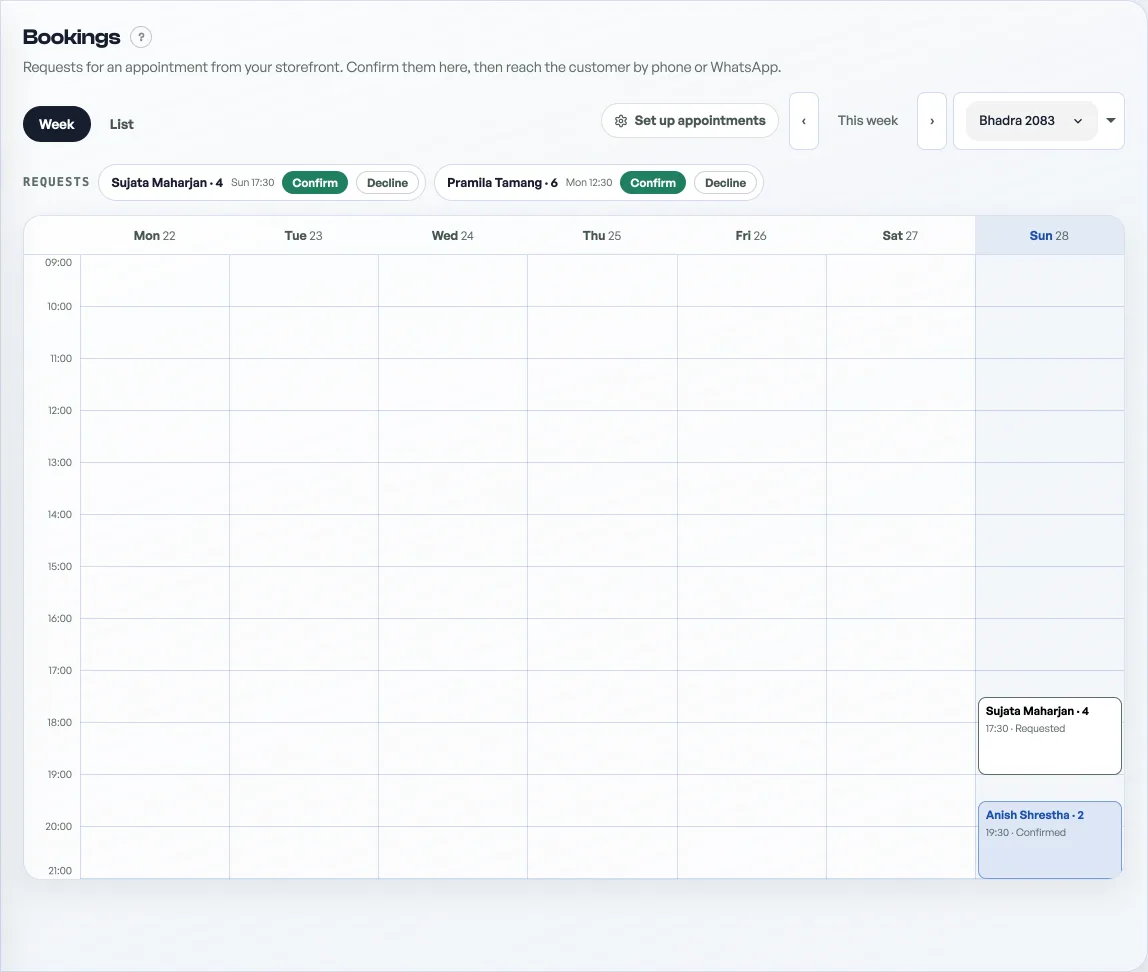
This is the sort of shop Pasal was built for. You pick a template, put up your services with NPR prices, and take bookings from your own page, in Nepali and English, with your own domain if you want one. You can run promo codes for the slow midweek days and give loyalty points to the regular who comes every month, which is cheaper than discounting everyone. eSewa and Khalti payments are on the way; until then, deposits work the way they already do in your chats, by wallet transfer, just with the policy written down properly.
Be clear about what an online diary will not do. It will not remind the forgetful customer by magic, it will not manage which beautician is on leave on Tuesday, and it will not stop the customer who books, confirms, and still does not come. It removes the chaos around bookings. The humans remain human.
Start before the season starts
The worst time to set this up is the week before Teej, when the chairs are full and the phone will not stop. The best time is a quiet Tuesday in the off season, when you can sit with a cup of chiya, write your price list honestly, decide your deposit rule, and put it all up in one sitting. On Pasal that sitting is short: a shop goes up in about five minutes, and the salon template is one of ten ready-made designs.
Then, when the season hits and someone messages at 9pm, you send one line instead of fifteen: "Book from the site, whatever slot shows free is free." That one line is the whole product.
If you want to see how a salon page looks before committing, browse the templates at https://pasal.studio/demo, or start yours at https://pasal.studio/start.