
It is four in the afternoon in Baneshwor. Nine tables, two staff on the floor, the espresso machine hissing. A table of students has been trying to catch the waiter's eye for five minutes, doing the polite raised-hand wave that nobody ever sees. Meanwhile the waiter is at the counter explaining that the cheesecake in the display finished at lunch, it just has not come off the menu yet.
None of this is a crisis. Most cafes in Kathmandu run exactly like this and run well. But a lot of the daily friction, the waving, the wrong orders, the menu that is always slightly out of date, comes from one thing: the menu is a laminated card, and every order lives in somebody's head until it reaches the counter.
A QR menu changes that one thing. Here is what actually happens when it does.
What a QR menu is, plainly
A QR menu is a small printed code stuck on the table. A customer points their phone camera at it and your menu opens in the browser. No app to install, nothing to download, no account needed just to look.
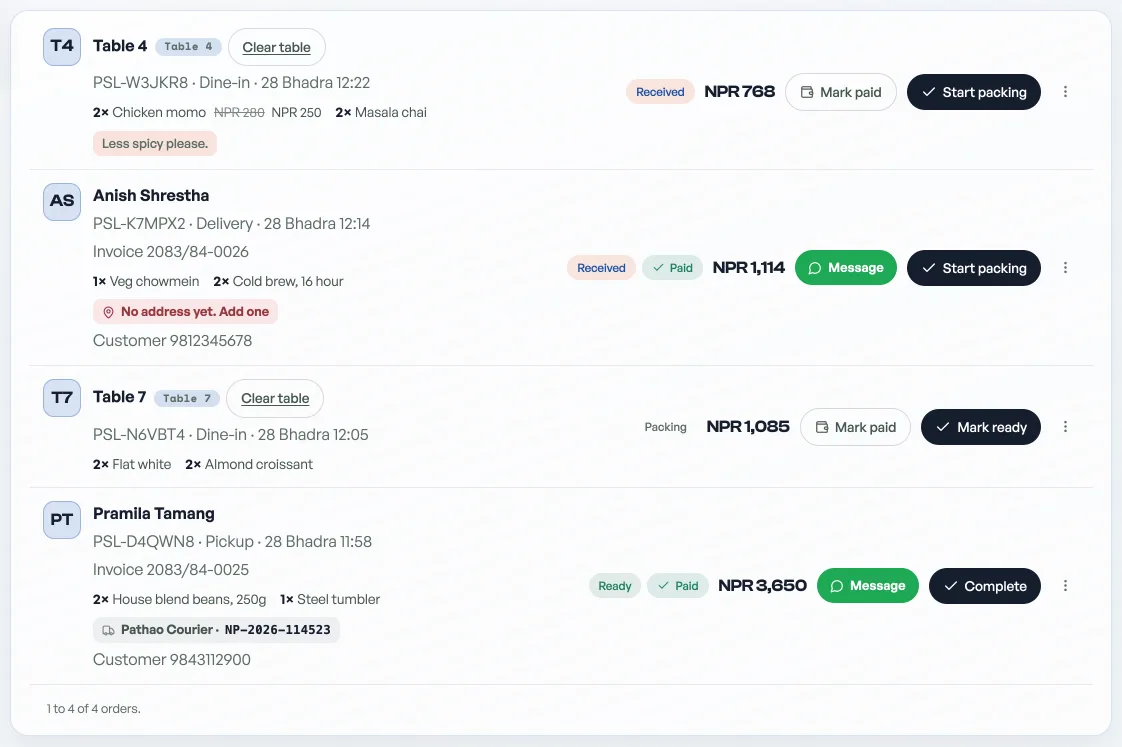
The half of the idea most people miss: on a proper setup, every table has its own code. So when someone scans and places an order, it arrives at your counter already labelled table four. Nobody asked, nobody scribbled, nobody shouted it across the room.
A QR code that just opens a photo of your old menu is only the first half. The ordering half is where the real change is.
The end of waving
Watch your floor for one afternoon and count how many staff journeys are pure order collection. Walk over, stand, listen, repeat it back, walk to the counter, repeat it again. On a full floor during the morning rush, or a Saturday in Thamel, that is most of what your staff do.
With table ordering, the customer browses and orders when they are ready, not when someone is free. The students take ten minutes deciding between cold coffee and lemonade; fine, nobody is standing over them. The solo customer with a laptop orders a second americano without breaking anyone's concentration, including their own.
Staff journeys become delivery and hospitality: carry the plate, check the table is happy, clear the cups. The walking that remains is the walking that earns you regulars.
Fewer wrong orders
Think about how an order travels today. The customer says it, staff hears it over the milk steamer, remembers it or scribbles it, walks it to the counter, repeats it. Four handovers, and each one is a place where chicken momo, less spicy, quietly becomes chicken chowmein.
When the wrong plate lands, you remake it. Say it is a NPR 600 bill for a table of three: one remade plate takes the margin out of the whole table, and they still leave slightly annoyed.
When the customer types the order themselves, there is exactly one version of it: the one they chose with their own thumb. Less sugar, no onion, extra achar, whichever options you offer. And because the order is written down, the end of the visit gets easier too. The bill is simply the sum of what that table's code ordered. No reconstructing at the till whether table two really had a second lemonade.
Menu edits without the print shop
Every cafe owner knows this ritual. Milk price jumps, so milk tea has to go from NPR 60 to NPR 70. Your choices are a sticker over every laminated card, which looks exactly as good as it sounds, or a fresh print run for the whole set, which you will put off for a month while the old price quietly costs you money on every cup.
A digital menu is edited from your phone. Change the price once and every table sees the new price on the next scan. The winter hot chocolate goes on in Mangsir and comes off in Falgun without any lamination. During Dashain you can put up a special sekuwa platter for the holiday crowd and take it down when the last guests leave the valley.
Sold-out items might be the best part. The cheesecake finishes at lunch, you take it off the menu in ten seconds, and nobody on the floor has to say the word finished for the rest of the day.
What tables and QR look like on Pasal
On Pasal, a cafe site takes about five minutes to set up. You pick one of 23 designed templates, put in your menu with prices in NPR, and add your tables. Each table gets its own QR code to print and stick down. The menu can run in Nepali and English, so the didi from the next gali and the tourist from the guesthouse both read it comfortably.
Orders arrive with the table number attached, and you run the day from the till at the counter. You can print proper PAN or VAT invoices for the customers who need them, set up promo codes or give a counter discount when the moment calls for it, and let regulars collect loyalty points on a customer account. The customer gets an email confirming the order and its status, so there is a record on both sides.
One honest note on payment: eSewa, Khalti and Fonepay are taken at checkout by your own wallet QR, with the customer’s transaction number and screenshot attached to the order; you confirm it when the money lands. The one-tap eSewa gateway, where eSewa tells the shop itself, is still to come. For now the customer orders from the table and pays at the counter, which, frankly, is how most cafes in Kathmandu already settle up.
And if you want the menu living at your own address, you can connect a custom domain, so the cafe on New Road can be the cafe's own name on the internet too.
The honest trade-offs
A QR menu is not magic, and it is not for every single customer.
- Some people will not scan. Older customers, tourists without data, anyone whose battery died in Patan traffic. Keep two or three paper menus behind the counter and take those orders the old way. QR is an addition, not a replacement.
- Your counter needs stable internet to see orders come in. Customers usually have their own data, but your side has to be reliable.
- The first week is teaching week. A small card on the table that says scan to order does most of the work, but staff should still offer help without being asked.
- Hospitality does not go away. Nobody becomes a regular because ordering was efficient; they come back because the coffee was good and somebody remembered their usual. The point of the QR is to hand the errands to the phone so your staff have time for the actual work.
Where to start
Do not overthink it. Put the codes on the tables for one month, next to the paper menus you already have, and watch one simple thing: how often staff walk to a table just to collect an order. If that number falls the way it usually does, you will know by the first busy Saturday.
You can see what a cafe with table ordering looks like at https://pasal.studio/demo, and when you are ready to set up your own, start at https://pasal.studio/start. Five minutes of setup is less time than one afternoon of waving.