
Of all the shopkeepers I talk to, the sunar is the surest that a website is not for him. Gold is not momo, he says. Nobody adds a tilhari to a cart and pays by card. He is right about that. Nobody sensible buys a wedding set worth, say, NPR 300,000 from a screen. But he is wrong about what a website is for. Nearly everyone who walks into a New Road showroom this year looked at shops on a phone first. The families who found nothing about your shop walked into someone else's.
Trust starts before the customer reaches the counter
Jewellery is bought a handful of times in a life. A wedding. Teej. A daughter's first real gold. The sums are frightening next to a monthly salary, and the buyer usually cannot test purity themselves. So the trade has always run on inherited trust: you go to your mother's sunar, because she went to her mother's.
That chain is thinner than it used to be. Families move from Gorkha to Baneshwor, children scatter to Sydney and Doha, and the mother's sunar retires. For the buyer with no inherited shop, the search starts on a phone. And here is the quiet truth: a shop with its own website, on its own domain, with real photos of real pieces, an address, a phone number and a face, looks like a shop that intends to exist next year. A shop that is only a name on a shutter looks, to a stranger, like a risk. The website's first job is not to sell. It is to look permanent.
Publish the numbers other shops whisper
Two fears sit in every jewellery buyer's stomach: is the gold what they say it is, and am I being played on the charges.
You already answer these at the counter. Answer them on the website too, before the visit:
- What you sell: tejabi, chhapawal, silver, and whether pieces are hallmarked.
- How you weigh: on a visible balance, in front of the customer, piece by piece.
- Your jyala, the making charge, stated per piece or per tola for common items.
- Your jarti policy, the wastage percentage, in plain words.
- Your exchange terms for old gold: the day's rate, what you deduct, and why.
Most shops treat these as counter talk. Flip that. The shop that writes, say, "plain sikri, jyala NPR 8,000 per tola, jarti 5 percent, hallmarked, old gold exchanged at the day's published rate" has just done something almost no competitor does. The customer who was burned once in another shop reads that page twice. This is what rate transparency means in practice: not a promise of cheapness, a promise of no surprises.
Sell by enquiry, not by cart
Now the part the sunar already knows. The daily gold rate is announced every morning, and it moves. If your website prints a full final price on every item, you must update it every day or the site quietly lies. A website that lies about gold prices is worse than no website.
So do not build a supermarket. Build a shop window. For each piece show the photo, the weight, the karat and the jyala, then say plainly: final price at the day's rate, call or come in. A 2-tola set is not an add-to-cart item. It is a conversation, a weighing in front of the buyer, a try-on, usually a second visit with the buyer's mother.
The website's job is the shortlist. And the shortlist is where the diaspora enters: the son in Sydney scrolls your site at midnight, sends three links to the family group, and on Saturday the mother is at your counter holding a phone with him on video. That sale happened because your pieces were findable, not because anyone paid online.
For the visit itself, Pasal has bookings. Wedding shopping is a delegation: five people, two hours, tea. Let the family book a Saturday sitting instead of standing three deep at the counter during the Mangsir rush. A booked hour with your best tray out is worth more than a crowded afternoon.
The bill matters almost as much as the bangle
In this trade the paper is part of the product. Customers keep gold bills for twenty years, because exchange value later depends on what the bill says now. A proper printed PAN or VAT invoice, with weight, karat, the day's rate and the jyala shown separately, is trust made physical. Pasal prints those from the till at the counter, and customer accounts keep the record even after the original slip has gone soft in a puja cupboard.
Then there is the oldest jewellery arrangement of all: paying over time. Trusted families have always built up to a wedding set in instalments, written in the shop's khata. The digital khata keeps that ledger where both sides can see it, entry by entry, so the balance is never an argument. The relationship stays warm; the arithmetic stays cold. That is exactly how credit should feel.
Loyalty points and promo codes exist on the platform too, and they make sense for silver, for pote and small gifts. For heavy gold, honestly, your discount is your jyala, and everyone knows it. Use the tools where they fit.
Gahana, a template drawn for this trade
Most website templates are built for t-shirts: tight grids, loud sale banners. Jewellery dies in that layout. Gahana is Pasal's jewellery template, and it does the opposite: pieces sit large and unhurried on the page, the way a good showroom window gives each set its own velvet stand. It is built for enquiry-first selling, not checkout racing.
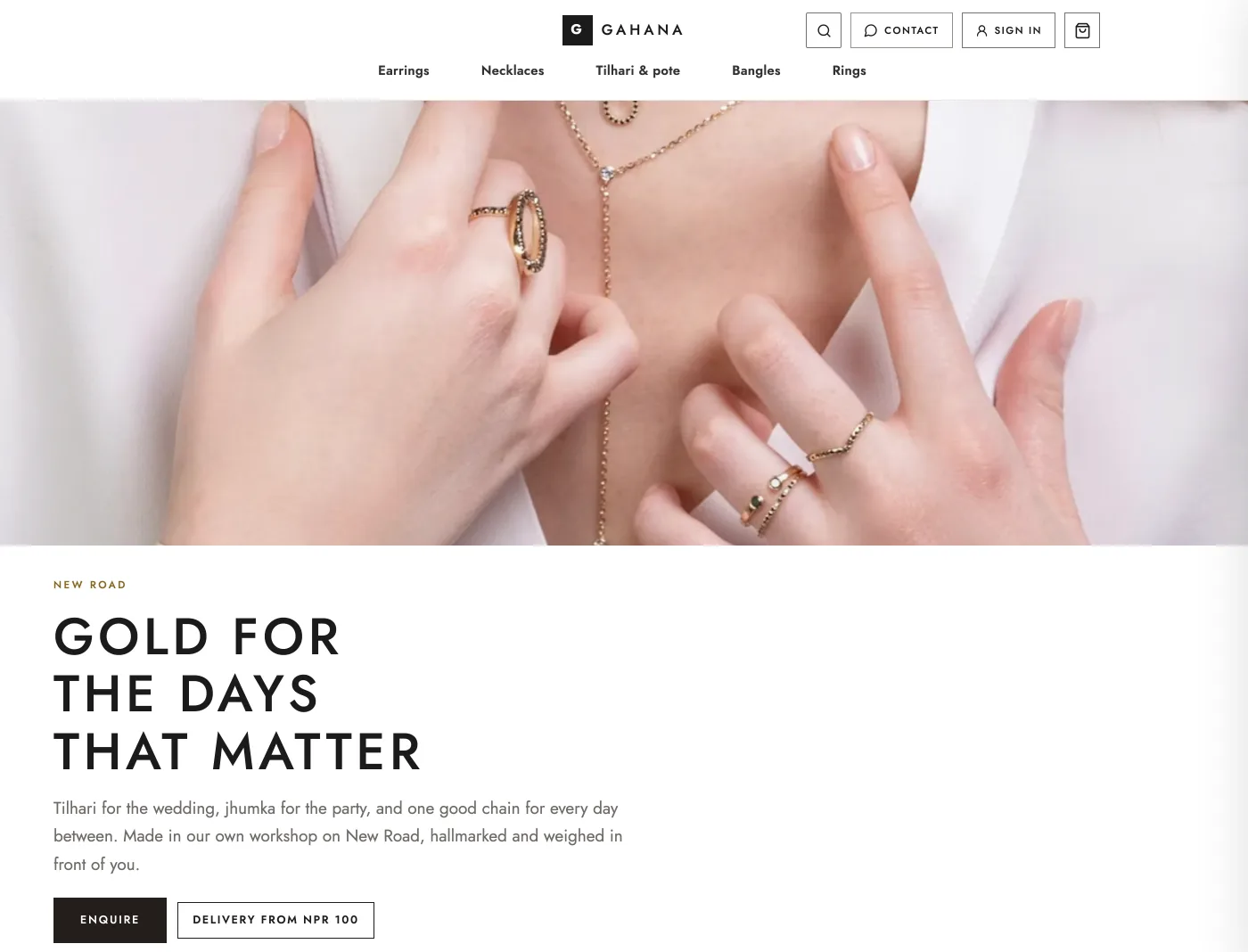
The practical parts: it is one of 23 designed templates, setup takes about five minutes, prices show in NPR, and the site reads in Nepali and English, so the grandmother in Patan and the son in Sydney see the same shop in their own language. Put it on your own custom domain and the address printed on your visiting card is finally yours, not a page inside somebody else's marketplace.
One honest warning: no template photographs your gahana for you. Photos matter more in this trade than in any other. Spend one afternoon by a bright window with a plain dark cloth and shoot every piece you are proud of. That afternoon will do more for the site than anything else on this page.
And payments: eSewa and Khalti are coming to the platform. Useful for a small silver order, perhaps. The 2-tola sale will remain what it has always been, a handshake at the counter with tea going cold beside the scale. That is not a weakness of the internet. That is the trade.
The window is open anyway
The sunar's instinct gets one thing right: gold runs on trust, and nothing replaces sitting across the scale from someone whose shop your family knows. A website does not replace that. It lets it begin earlier, before the shutter is up, in a rented room in Doha, in a search on a phone in Baneshwor. The buyers are already looking through the glass. The only question is whether your window has anything in it.
See the Gahana template with your own eyes at https://pasal.studio/demo.