
Anyone who has run the door at a small event in Kathmandu knows the scene. A folding table, a cash box, a cousin holding a copybook of names, and a queue of people waving passes at you in the cold. Half the passes are folded photocopies. Someone swears their friend paid for three but the copybook says two. It is 6:40, the show starts at 7, and the sound guy is asking about his advance.
Paper passes work fine when everyone at the event knows everyone else. The moment your gig, comedy night or reception grows past your own circle, paper starts costing you money, arguments and sleep. Here is what moving tickets online actually changes for a small venue or a wedding planner in Nepal, and, just as important, what it does not.
What a paper pass really costs
Start with the obvious cost. You design a pass, take it to a press near New Road, and print a few hundred. That is a real bill before you have sold a single seat, and if the event gets postponed, those passes are scrap.
Then the quiet costs. Distribution: your passes end up sitting at two cafes in Thamel and a friend's shop in Patan, and every evening you ring around asking how many moved. Counterfeits: a photocopied pass under dim rooftop lighting looks exactly like a real one, and one gatecrasher with a fake emboldens five more. Reconciliation: at midnight you sit with a pile of torn stubs and a cash box, and the two never quite agree. Say you ran a 150 seat show at NPR 500 a ticket. That is NPR 75,000 moving through the evening, and with paper you find out where it went only after the fact, if at all.
None of this is anyone cheating you, mostly. It is just that paper cannot count itself.
The gate list is the real product
Here is the mental shift that matters. The ticket is not the product. The ticket is a receipt. The real product is the gate list: one accurate, live record of who paid, how much, and whether they have entered yet.
When someone buys online, their name lands on that list the moment the order is placed. No copybook, no "my friend told your friend". When your venue holds 150 people, the list stops at 150. You physically cannot oversell the way you can when three cafes each hold a stack of passes and nobody knows the running total.
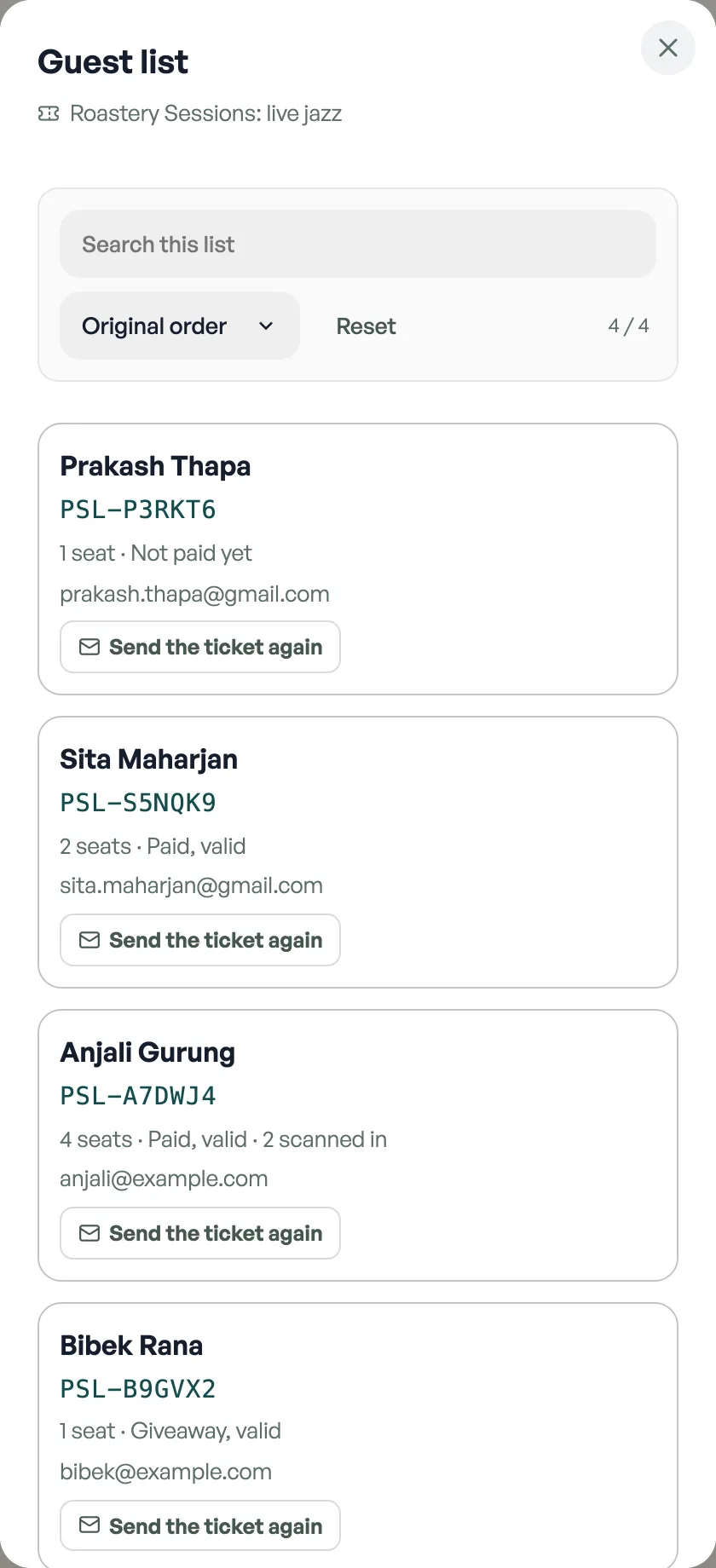
For the buyer, the ticket arrives by email with its own QR code. Nothing to collect from a shop across town, nothing to forget in another jacket during Dashain travel. On Pasal, each event ticket carries its own QR and the order email goes out on its own, so your evening at the laptop stops at setting up the event page.
QR check-in versus a cousin with a copybook
At the door, the difference is speed and certainty. A guest shows the QR on their phone, your volunteer scans it with an ordinary smartphone, green tick, in they go. Two or three seconds. If someone screenshots a ticket and sends it to a friend, the second scan flags that this ticket already entered, and now the argument is short: the code was used at 7:12, take it up with whoever sent it to you.
Compare that with the copybook: find the name, squint at the handwriting, check the tally marks, hold up the queue. A queue that moves fast is not a small thing. People arriving at a Baneshwor banquet hall in wedding clothes do not want to stand in the lane for ten minutes.
Be honest about the practicalities, though. Your scanning phone needs battery, so keep a power bank at the table. Venue internet can wobble, so know your mobile data works there before doors open. And always print the gate list once, that afternoon, as a paper backup. Online ticketing removes the copybook, it does not remove the need for one calm person at the door.
Sold out is a marketing moment
Paper passes hide your best marketing. When tickets are scattered across counters, you never know the true count, so you can never honestly say "only 20 left". With one online count, you can, and scarcity that is actually true is the most persuasive line you will ever post.
Small venues in Nepal have natural scarcity built into the calendar. A Shivaratri night event, a pre Dashain show before everyone leaves the valley, a New Year countdown in Thamel: these have a hard date and a hard room size. Post the link, post the honest countdown as seats go, and when it sells out, say so loudly. "Sold out in four days" on this event is the advertisement for the next one, and it costs nothing.
Promo codes help you steer the early rush. Give your first fifty buyers a code worth, say, NPR 100 off, and you convert your loyal crowd into the early sales that make everyone else hurry. Pasal handles promo codes and counter discounts, so the early bird price and the door price can both exist without two sets of paper.
What wedding planners and banquet halls actually need
Weddings are the interesting case, because nothing is being sold. Nobody charges their relatives for entry. But a planner running a 500 guest reception has exactly the same problem as a gig organiser: who is allowed in, how many, and is the count real.
The season after Tihar makes this concrete. A hall in Baneshwor might turn around three receptions in a week. Caterers charge per plate, so the difference between 450 confirmed guests and "somewhere around 500, maybe 550" is real money, plate by plate. Free tickets with QR check-in give the planner a live headcount at the gate: how many of the groom's side have arrived, whether it is time to tell the kitchen to fire the second round. For a mehendi night or a reception where the couple genuinely worries about uninvited plus fours, the QR at the door settles it politely, without an aunt having to play bouncer.
Event venues themselves can go one step further and put their calendar online: ticketed public events on some nights, private bookings on others, all on their own website under their own domain rather than a phone number scribbled on a banner.
The honest trade-offs
Online tickets are not magic, and pretending otherwise helps nobody.
- Payment collection still takes thought. On Pasal, eSewa, Khalti and Fonepay are taken at checkout by your own wallet QR, with the customer’s transaction number and screenshot attached to the order; you confirm it when the money lands. The one-tap eSewa gateway, where eSewa tells the shop itself, is still to come, so today you confirm payment the way you already do, at the counter or by transfer, while the ticket, the QR and the gate list handle everything after the money.
- Some guests are not phone people. An older guest at a bhajan evening may hand you a printed email or nothing at all. Keep that printed backup list and wave them through with grace.
- You depend on electricity and data at the venue. Plan for both, the same way you plan for the generator.
- A ticket link only sells if people see it. Online ticketing replaces the copybook, not the poster, the group chats and the friends who share your event.
Start smaller than you think
Do not wait for the big show to try this. Run your next 40 seat open mic or momo night with online tickets and QR at the door. The stakes are low, your volunteers learn the scanning rhythm, and you will see your first honest gate list by 8 pm instead of midnight.
Setting the event up takes minutes, not a week with a printing press. Create your venue's site and first event at pasal.studio/start, or look at the templates first at pasal.studio/demo. The cousin with the copybook can finally watch the show.