
Walk into any kirana pasal in Baneshwor at seven in the evening and you will find two ledgers running at once. The first is the cash box. The second is the khata: the fat register with the red cloth binding, corners gone soft from years of thumbs, where the whole neighbourhood's udharo lives. The didi from the third floor takes milk, eggs and noodles all month and settles after payday. The tailor two doors down takes thread and lining and pays when his stitching money comes in. Nobody signs anything. Everybody knows.
That book is not a weakness of Nepali retail. It is the engine of it. But it is also, quietly and steadily, the leakiest thing in most small shops. Paper does not lose money in one dramatic moment. It loses money one forgotten line at a time.
Credit is the business, not a favour
People outside retail imagine udharo as an occasional kindness. Shopkeepers know better. For a kirana, credit is the monthly rhythm of the whole tole. Salaries land at the start of the month, the khata fills through the middle, and the last week is settling week. A fabric shop in New Road runs the same way on a longer cycle: a boutique owner takes cloth in Asar, sells the finished kurtas through Shrawan, and clears the account when her own customers pay her.
Refusing credit is not really an option. Tell a ten year customer no udharo today and she will walk thirty metres to the next shop, and her whole family's shopping walks with her. So the real question is never whether to give credit. It is whether you can see, at any moment, exactly how much of your money is sitting in other people's kitchens.
With a paper khata, the honest answer is almost always no.
Five ways the paper book leaks
The forgotten entry. It is 6 pm, the counter is three deep, someone's child is asking for a Wai Wai and someone else needs change for a thousand. You hand over the sugar and the dal, tell yourself you will write it after the rush, and you do not. Say that basket was NPR 350. It is simply gone, and you will never even know it existed.
The disputed total. Settlement day comes and the customer squints at your handwriting. Was that 700 or 900? Did she already pay the entry from the 4th of Baisakh? You cannot prove it, she genuinely does not remember, and because she is a neighbour and not a stranger, you round down to keep the peace. Do that with twenty customers a month and you have donated a real salary.
The book itself. One register, one copy, kept under the counter next to the water jug. A spill, a rat, a move to a new shutter, one enthusiastic Dashain cleaning by a helpful nephew, and years of balances are gone. There is no second copy. There was never a second copy.
The invisible total. Ask a shopkeeper how much udharo is out right now and you will get a shrug: maybe seventy, eighty thousand? Maybe a lakh? Nobody sits down and totals three hundred scribbled pages. Which means you are running an interest free lending business of unknown size, funded by the same cash you need to restock before Dashain, and you never actually decided to do that.
The awkwardness tax. This one is the quietest. You do not remind people, because reminding means flipping pages in front of them and doing arithmetic out loud, and that feels like an accusation. So old balances just sit. The longer they sit, the harder the conversation gets, and some of them simply age into gifts.
What actually changes on a screen
A digital khata is not a complicated idea. It is the same book, except every customer has their own page, every entry has a date and an amount, and the totals add themselves up. That small change removes almost every leak above.
The entry takes seconds at the counter, in the same place you already ring up the sale, so the 6 pm rush stops eating baskets. The customer's balance is one clear number, not an argument, so settlement day becomes: here is the screen, here is the total, done. The book cannot be lost to a spill or a house move because it is not a physical object under the counter. And the number you could never get from paper, total udharo across the whole shop, is just there, every morning, before you open the shutter.
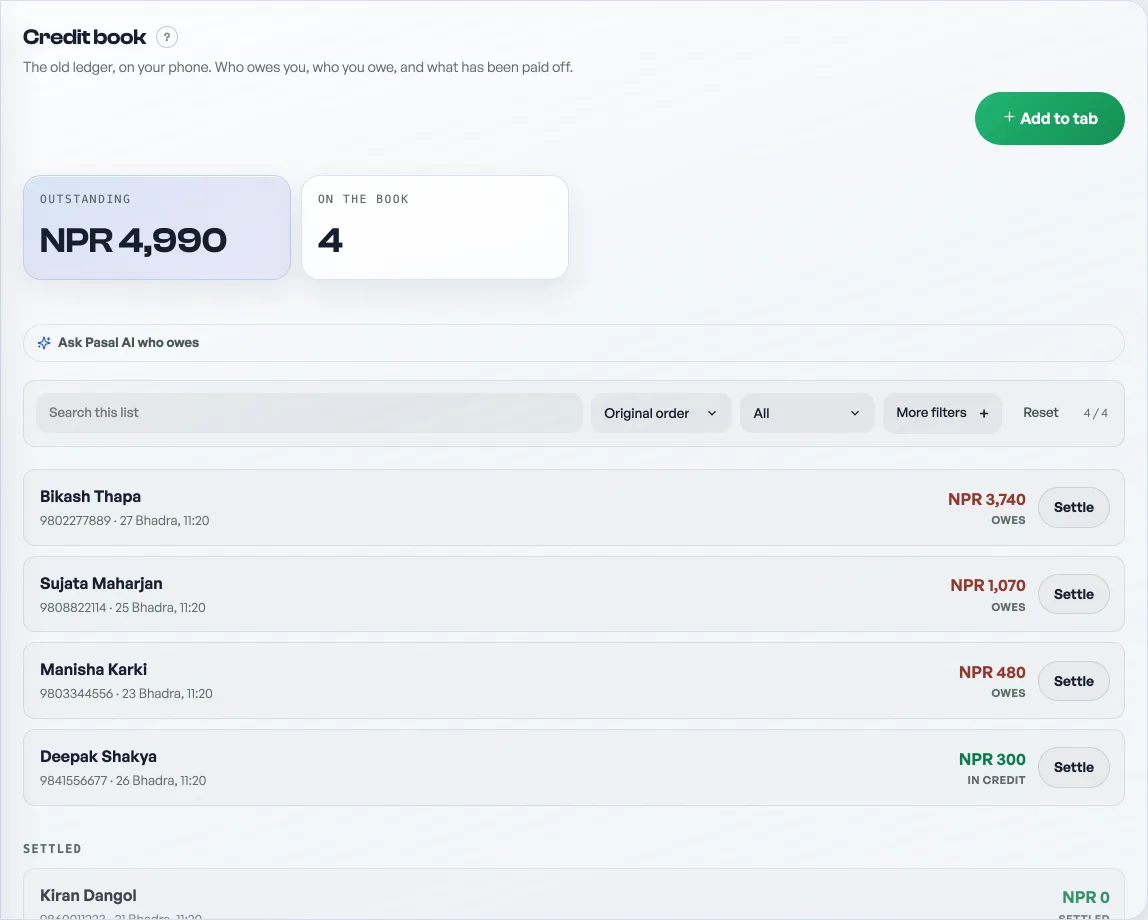
This is why we built a digital khata into Pasal. It sits inside the same shop site that holds your catalogue and your till, it works in Nepali and English, and each customer's credit lives against their account rather than against your handwriting. When someone pays something off, you enter the payment and the balance moves. When they take goods on credit, one line, and the page is current.
The awkwardness tax shrinks too, in a way that surprises people. Showing a clean on screen balance feels neutral, almost official, the way a bank statement does. You are no longer accusing anyone. You are both just looking at the same number.
The trade-offs, told straight
I will not pretend the screen is free of costs, because it is not.
You need a working phone or a laptop at the counter, and Nepali shop life includes power cuts and dead batteries. A scribble in a paper book needs nothing. Some older customers trust the visible register precisely because they can watch you write in it; a screen they cannot read feels like a black box, and you will need to show it to them patiently the first few times.
And discipline does not disappear. A digital khata records nothing you do not enter, exactly like paper. If you skip entries during the rush, the screen leaks the same way the register did. What changes is that an entry takes a few seconds instead of finding the page, finding the pen, and doing the sum.
Be clear eyed about one more thing: Pasal's khata will not collect your money for you. Nobody rings your debtors on your behalf. The asking is still yours to do. What you get is that the number is never again arguable, and that alone changes how those conversations go.
How to switch without breaking anything
Do not try to type in three hundred pages of history. Pick a natural settling point, and in Nepal the best one is obvious: the weeks around Dashain, when most accounts get cleared anyway. Carry forward only the balances that survive settlement, one line per customer.
Run the paper book in parallel for the first month if it makes you comfortable. Tell your regulars plainly what you are doing: the khata is going on the screen so there are no more disagreements about totals. Most people take that as a compliment to their honesty, not a threat.
Then watch the total outstanding figure for a few weeks. Nearly every shopkeeper who sees that number for the first time is startled by it. That startle is the point. It is money you had already lent, invisibly, for years.
The book was never the point
The red register was never sacred. What was sacred was the trust underneath it: the shop that knows your family, holds your account through a thin month, and gets paid when the salary comes. A digital khata keeps all of that and throws away only the leaks, the disputes and the guesswork.
If you want to see how it feels, a Pasal shop takes about five minutes to set up, khata included: pasal.studio/start.